Wednesday, August 31, 2016

Monday, August 29, 2016
Restaurant Website SEO – What You Need To Know

Organic SEO helps drive the right traffic to your restaurant website.
Just the mention of those three little letters, SEO, can send many restaurant owners and managers into a slight panic.
The term, search engine optimization (SEO), carries with it an aura of mystery that only a few individuals seem privy to.
In this article, we look at restaurant website SEO and what you need to know. We demystify the term and show you that there are things you can do to optimize your restaurant website for search.
Defining SEO
Let’s succinctly define SEO. It’s the focus on and strategy you use to grow the visibility of your restaurant’s website through organic, non-paid ways.
SEO encompasses several different technical and creative elements to:
- Improve search page rankings
- Drive traffic to your site
- Increase search engine awareness
You’ll find several aspects to SEO as well. These can include the text on your page, the user experience and the way your site is structured.
Why Does It Matter?
If you want the major search engine in the world, Google, as well as Bing and Yahoo! and others to help you generate traffic to your restaurant site, then it matters.
While social media, paid ads and email marketing can generate traffic to your site, search engines are the most common way users get to your site.
This is especially true for restaurants. Why?
Well, everybody needs to eat, and whether they’re eating in their hometown or while on the road, your potential customers are looking for a restaurant They’re searching for your address, your menu and your phone number.
This is why SEO is important.
Search engine traffic, or lack of it, can make or break your business. (tweet this)
You’ll also find that search engines are working hard to provide relevant search results. If you haven’t fine-tuned your SEO, you aren’t going to show up at the top of search results or even on the first page.
Studies show that web searchers view less than 2% of searches below the top five results on the first page. So, you can see what happens if you don’t pay attention to your restaurant website’s SEO.
Now, let’s look at some tips for improving your SEO.
Website Basics
First, your website should have some basic information on it.
- Your address and your phone number. This should be right at the top of your page. It’s important that this is on both the desktop and mobile versions of your website. You also want to put it in your footer and most certainly on your contact page. Consider adding a Google Map to your contact page as well.
- Professional quality photos
- Your menu – do not use a pdf menu or a menu that is a graphic. Use text.
- Customer reviews and testimonials – again, use text, not images. Google loves reviews.

Inbound links from other sites like social media can help your SEO.
Best SEO Practices
Once you’ve got the basics of your restaurant website, you want to make sure you pay attention to some best practices for SEO.
- Your website must be mobile-friendly. This is non-negotiable, especially when it comes to Google.
- Build a user friendly website. This means anticipating your website visitor’s needs in much the same way you would at your restaurant.
- Pay attention to your navigation menu. Test it before launch with someone unfamiliar with your site to see if it works well for them.
- The usability of your website also matters when it comes to SEO. For example, is your navigation intuitive? Can users get where they need to go without getting bogged down and confused?
- Ensure a quick-loading site. Google is known to reward fast loading sites and penalize slow sites. Why? Because Google knows you’ve created a good user experience if your site loads quickly.
- Label your pages appropriately. You want a page for about us, contact, reservations, menu, events, etc. Label them just what they are. Your goal is a clean, clearly-labeled site.
- Pay attention to your meta tags. Each page needs its own unique title. If you’re using an SEO plugin, and you should be, make sure to fill out the keyword info, title and description.
- Use keywords and long-tail keywords on your pages, but don’t over stuff.
- Fill out image tags. Give each of your photos an alt and title description.
- Add fresh content often. A blog is a good way to do this.
- Incorporate videos.
Facebook Places
While this isn’t SEO on your website, it pays to list your restaurant here. You absolutely want a presence on Facebook because quite possibly that’s where you’ll find the majority of your customers.
In addition, you can link back to your website in your daily posts which drives traffic to your restaurant website and can boost your search engine rankings.
When creating a Facebook business page, be sure to pick the right category (local business is perfect). Then, you’ll want to completely fill out the info with:
- A description
- Map to your restaurant
- Your website, email, phone and address
- Our menu
Now, you’re all set for check-ins and reviews and linking back to your website.
Claim Your Google+ Page
Lastly, we can’t emphasize this one enough.
Google is the giant of the search engine world. If you don’t have a business listing with Google, they aren’t going to look kindly on your restaurant website.
Google gives a nod to websites with Google+ page listings. This means they’re apt to list your search results higher than restaurants without a Google+ page.
It’s easy to claim your page. Do a search for your restaurant on Google or Google Maps. If you find your restaurant listed on Google, select “Manage this page” and sign in with a Google account. Then you can verify that you are indeed the restaurant owner.
Verification can come in the form of a phone call at your restaurant or a postcard mailed to you.
If you don’t see your restaurant listed, you can create a new page on your own.
You also want to check out Google My Business. It’s another place to provide Google with information that then can be used on Google Search, Maps and Google+.
Final Thoughts
Now that you have a basic foundation in restaurant website SEO, you have what you need to get started.
Remember to keep your site clean and user friendly. Update your site frequently with reader-friendly, socially-shareable valuable content for the best search results. (tweet this)
Don’t create a website and forget it. Your restaurant website is something to revisit often to fine-tune your content for the best user experience that also enhances your SEO.
The goal of your website is to meet your customers’ needs. To do that, they have to be able to find you through their search engine of choice.
Dive into your restaurant website’s SEO today and use your Google Analytics to gauge your success.
Do you have a great website? Is it user-friendly and enticing to your website visitors? If not, or you’d like a website tune-up and refresh, contact us for your free website consultation. We’ll make sure your website works for your site visitors and is the centerpiece of your marketing.
Images: Dan Gold and Patrick Tomasso
Thursday, August 25, 2016
Top 3 Technology Trends for Restaurants
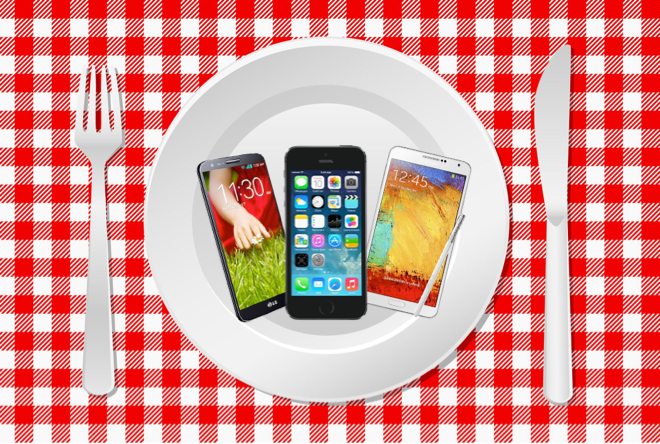
Technology is changing eating out. The use of mobile phones and online access is changing how customers find and experience eating at restaurants. But what exactly is happening out there and how can restaurants grasp onto these trends to improve their business and build better relationships with the customers?
Hello, this is Drew Adams, owner of Restaurant Engine. Restaurant Engine will have a booth at the North Carolina Restaurant and Lodging Expo on August 29 – 30 in Raleigh, North Carolina and I will be speaking on a panel dedicated to Restaurant Technology.
In the run-up to the being on the panel, I thought I would like to outline three trends in restaurant technology especially as it pertains to online and mobile usage and how your restaurant can leverage them.
Trend: Mobile search
In 2015 Google announced that mobile searches had overtaken desktop searches in 10 countries including the US and Japan.
Google says the results of a survey of online mobile searching shows that 55% of people using mobile devices for research want to purchase within an hour and 83% want to purchase within a day!
Of the people searching for restaurants specifically 70% considered making a purchase and 54% actually made a purchase. For restaurants being seen or shown during what Google calls these “micro-moments” is a huge opportunity to gain new business.
Consider this story from a typical restaurant customer.
“If I am in a town I do not know I do an internet search, “best restaurants Charleston”, and I always go to Trip Advisor…sometimes Yelp….and ask for the top restaurants, read the ratings, check the budget, often then I will go to the restaurant’s website check out the menu, see the ambiance, and sometimes I call directly. If it is before hours I will use Open Table to check availability and make a reservation. If there is not availability and I really want to go I will call the restaurant. I do all this on my phone.”
But the most important part of the diner’s description above is probably, “I do all this on my phone.” Think about that. Checking location, menu, reviews, setting reservations – things that back in the 90s would have taken several conversations among friends, a subscription to Zagat, a phone book, and, yes, a push button phone – all done now on a 5 inch x 3 inch screen in the palm of a hand!
According to Google’s Think Insights, 59% of those researching online will visit the business’s website and the ones who actually make a purchase come an average of 6 times to the website. An OpenTable survey says that 86 % of diners regularly check out menus online before they dine out.
The bottom line is that it all re-inforces the upmost importance of having a good mobile website. And in a world with Yelp and TripAdvisor and the like, the restaurant’s website is the restauranteur’s chance to “make the case” to the customer directly on why they should visit the restaurant and give them an idea of what they will experience when they come.
Studies have shown the most enjoyable part of a vacation is the anticipation. Considering this, I would propose that the restaurant’s website has another function, and that is to set diner excitement. In doing that, you are actually creating the first moment of the diner’s experience and influencing the overall enjoyment of the meal.
What technology to use to be a part of the trend
- Make sure you have a website that is optimized for mobile.
- Make sure you are in Google Location.
- Make sure the basics like your address and phone number are easily accessible.
- Use images that convey the experience the customer can have coming to your restaurant.
Trend: Mobile apps
An OpenTable survey earlier this year found that 56% of consumers said they were “very unlikely” or “unlikely” to download an app for an individual restaurant, compared with 6% who said they were very likely to download such apps.
But, that being said, it’s impossible to ignore the mammoth success of the Starbucks app. Consider these statistics:
- 16% of total transactions in quarter ending December 2014 were paid for by the app
- 21% of total transaction in quarter ending December 2015 were paid for by the app
In fact, customers have preloaded $1.2 billion dollars onto their Starbucks accounts, which makes Starbucks the same size as a healthy mid-sized bank!
Its clear that customer will use apps. Mobile apps give customers several advantages that they love including:
- Gaining rewards for purchases
- Pre-order ability (avoid lines)
- Quickly finding locations close by
Likewise restauranteurs also gain from being able to:
- Reward repeat customers
- Increase efficiency
- Have a detailed order history data on customers
- Send App notifications – via GeoFencing or Beacons
Clearly, it is working for franchise like Starbucks, but how important is having an app for single independent restaurants? I believe this questions is playing out in the marketplace today. There are some relatively cheap options so you can experiment with having an app if you want one. If you have take-out and delivery or a chain with multiple locations, I would advise experimenting with one and see how it affects your total take-out volume and speeds adoption of your loyalty programs.
What technology to use to be a part of the trend
Here are a few ways to tackle the app building task:
- Hire your own app developer and incorporate the features you want.
- Use a third party solution that has pre-built features. Here are some companies that offer these services.
- Levelup
- MojoBistro
- OpenDining
Trend: Online Ordering
Panera, which defined online ordering as ordering done via kiosks, mobile or the web, says that in cafes that have been converted to the 2.0 model specifically, they account for more than 20 percent of retail sales, and it reaches 30 percent for 2.0 cafes converted more than a year, he said.
LevelUp research indicates that customers who have placed an order online visit the restaurant 67 % more frequently than customers who haven’t.
Our partner OpenDining says that online orders are 22% larger than comparable call-in orders and also add on average an 18% increase in total, non-dine-in orders.
Online ordering gives advantage for consumers to
- Skip lines
- Saved preset likes and dislikes
- Get items delivered
Online ordering has increasingly been a no-brainer for restaurants that offer take-out or delivery.
What technology to use to be a part of the trend
Online ordering consists of subscribing to online ordering provider and then putting your menu into their system.
Online orders can be received via fax, text or email as a baseline, but even better is if they are connected directly to your point-of-sale systems on site so the orders can appear in your systems as if keyed in by waitstaff. This is supported by most point-of-sale system. Here at Restaurant Engine we partner with Open Dining to provide online ordering features and then we integrate the ordering into a restaurant’s website.
Conclusion
Use of online technology in the process of eating out has been increasing and signs show will continue to increase. Customers want to use mobile phones and online media to locate and research restaurants, make reservations, order their meals, pay for those meals and earn rewards. Keeping up with these technology trends can be daunting but can reap big rewards for companies with increased traffic, order size and customer satisfaction.
Wednesday, August 24, 2016
Now You Can Have Lady Gaga’s Meat Dress and Eat It Too

This is a pretty daring look for Barbie
Remember when Lady Gaga wore a dress made of raw meat? (It was flank steak, FYI.) While high-end designs worn by celebrities are often replicated by fast-fashion brands and sold to the masses, a cheaper version of Gaga’s carnivorous couture gown sadly never popped up at Forever 21. But finally, six years later, you can order your very own miniature replica of the frock at a hotpot restaurant in China.
Chinese hot pot restaurant, taking the Lady Gaga #meatdress to whole new extremes #火锅 #becauseChina pic.twitter.com/jN0bL32T7w
— Elyse Ribbons 柳素英 (@iheartbeijing) August 21, 2016
As RocketNews explains, "The idea is that you’ll peel the layers of meat off of the doll to put into the hotpot. As you do, the doll’s body will become more and more exposed with each slice removed."
The idea of eating mutton dressed as lamb Barbie isn't sitting well with everyone, however: Some diners have complained that the gimmick is sexist and/or unhygienic. Nonetheless, this may be the best shot you've got at fulfilling your meat dress fantasy.